

vs Chatbot
Chatbot: open-ended response layer. Surface Assistant: compiled intent layer for one page. No unrestricted live model is required; answers come from prepared source material that can be validated before deployment.
Static pages make visitors hunt. Surface Assistant turns one page into a bounded conversation layer that answers from approved material, routes to proof, and guides the next step.
The problem
Most websites publish information and leave the visitor to figure out what matters. People arrive with practical questions: what is this, is it for me, how does it work, where is the proof, and what do I do next?
The point is not adding more AI. The point is fewer confused visitors, fewer repeated explanations, and a page that can answer from material you already approved.
A static page often forces the visitor to hunt for the simplest explanation.
Fit questions are usually buried in copy, not available when the visitor needs them.
Proof links exist, but the page rarely guides someone to the right evidence path.
The CTA appears before the visitor understands enough to trust it.

The core idea
Surface Assistant is not designed to answer anything. It is designed to answer the questions that naturally arise inside one page, offer, proof system, or operating surface.
Use probabilistic intelligence to generate the map. Use deterministic architecture to control the territory.
How it works
Positioning
Chatbot: open-ended response layer. Surface Assistant: compiled intent layer for one page. No unrestricted live model is required; answers come from prepared source material that can be validated before deployment.
FAQ: static question list. Surface Assistant: rough intent, objections, follow-up awareness, proof routing, and conversion-aware next steps.
This is not a support inbox or human-staffed chat. It is a page-native guide designed to explain, route, qualify, and prove.
The runtime does not need to improvise when the answer pack, proof routes, fallback rules, and action paths already exist.
Inspect the surface
A serious buyer or technical reviewer should be able to inspect what the page answers, what it refuses, where proof lives, and what happens when confidence is low.
Compiled answer layer for one page. No unrestricted live model is required for the public runtime.
Prepared routes for fit, proof, pricing, objections, limitations, update lifecycle, and action handoff.
Low-confidence or off-topic inputs should clarify, recover, or route back to safe topics instead of improvising.
Live surfaces show the same browser-native architecture under different domain pressure.
Requests stay inside configured fields, confirmation, sanitization, dry-run/live mode, and visible handoff boundaries.
Not full support, not account-specific help, not a substitute for weak source material, and not maintenance-free.
Controlled action handoff
Surface Assistant can guide a visitor into a limited request flow: demo, call, text, contact info, operator question, or follow-up. It collects only required fields, validates input, asks for confirmation, sanitizes the payload, and submits through configured action mode.
Before a request leaves the page, the assistant should confirm the payload, keep to configured fields, avoid hidden configuration, and log the handoff mode. It should not invent promises about pricing, timeline, scope, or guarantees.
Proof graph
These are four deployments of the same browser-native surface architecture across different domains.
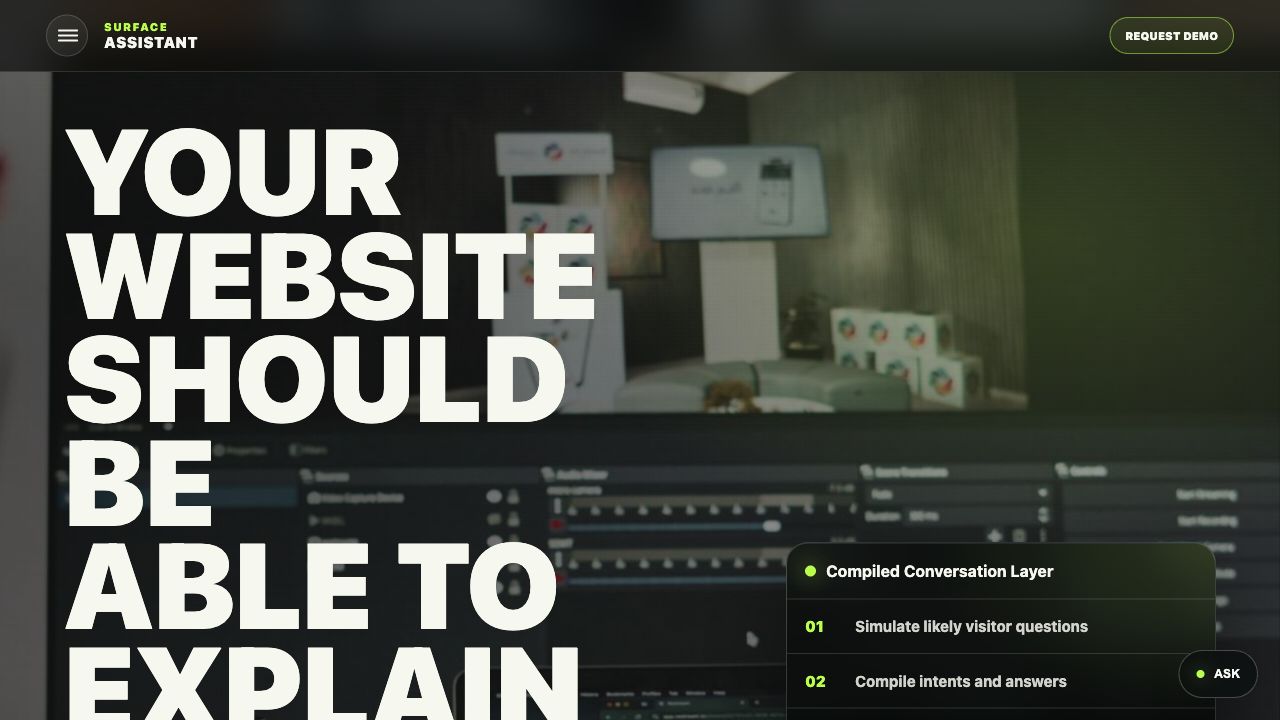 Reference product surface
Surface Assistant
Reference product surface
Surface Assistant
Proves: the reference shell, bounded assistant behavior, action handoff, proof routing, and public explanation layer.
Source posture: controlled answer material and documented authority chain.
Limit: not a general chatbot or live data product.
Open Ask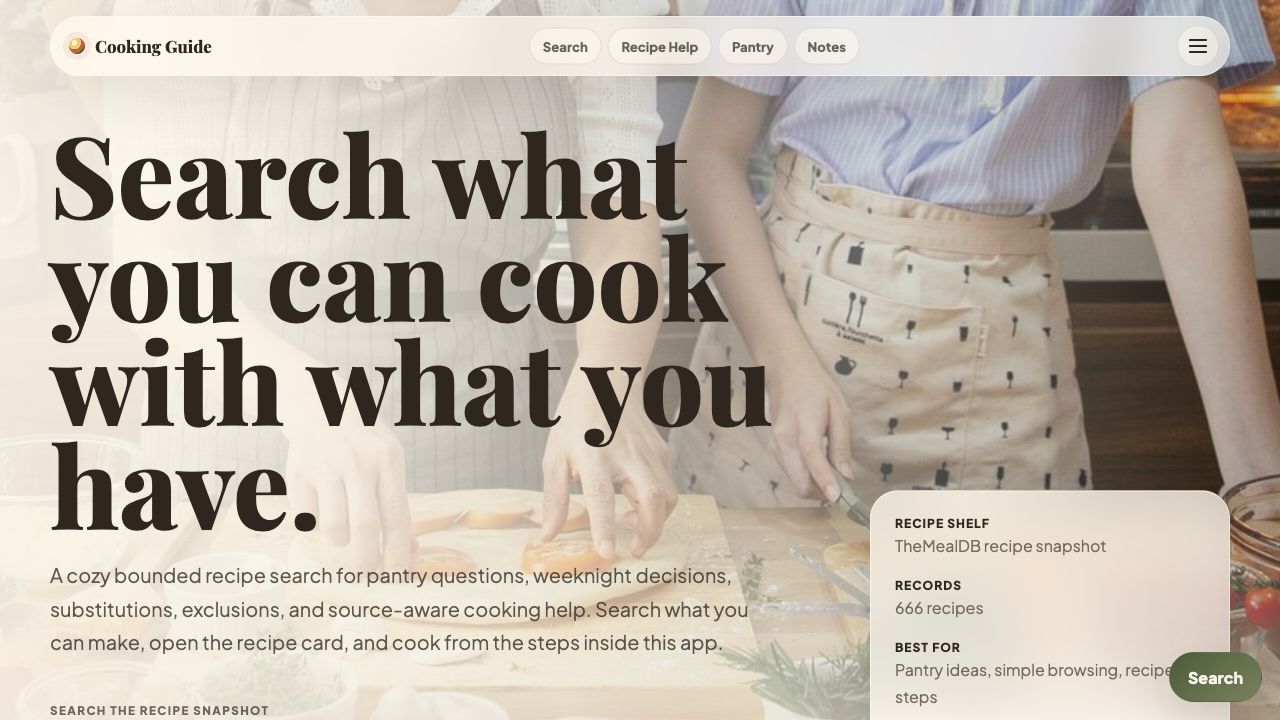 Bounded search surface
Cooking Guidance
Bounded search surface
Cooking Guidance
Proves: dataset-backed recipe search, exclusions, saved state, source views, and mobile-first recipe detail flows.
Source posture: compiled recipe snapshot with visible provenance.
Limit: no allergy guarantees or medical nutrition advice.
See live surface High-context offer surface
PE Coaching
High-context offer surface
PE Coaching
Proves: complex buyer education, foundational terms, skepticism handling, proof limits, and CTA routing.
Source posture: curated public reference context plus prepared offer material.
Limit: no private fund, portfolio, or confidential company data.
See live surface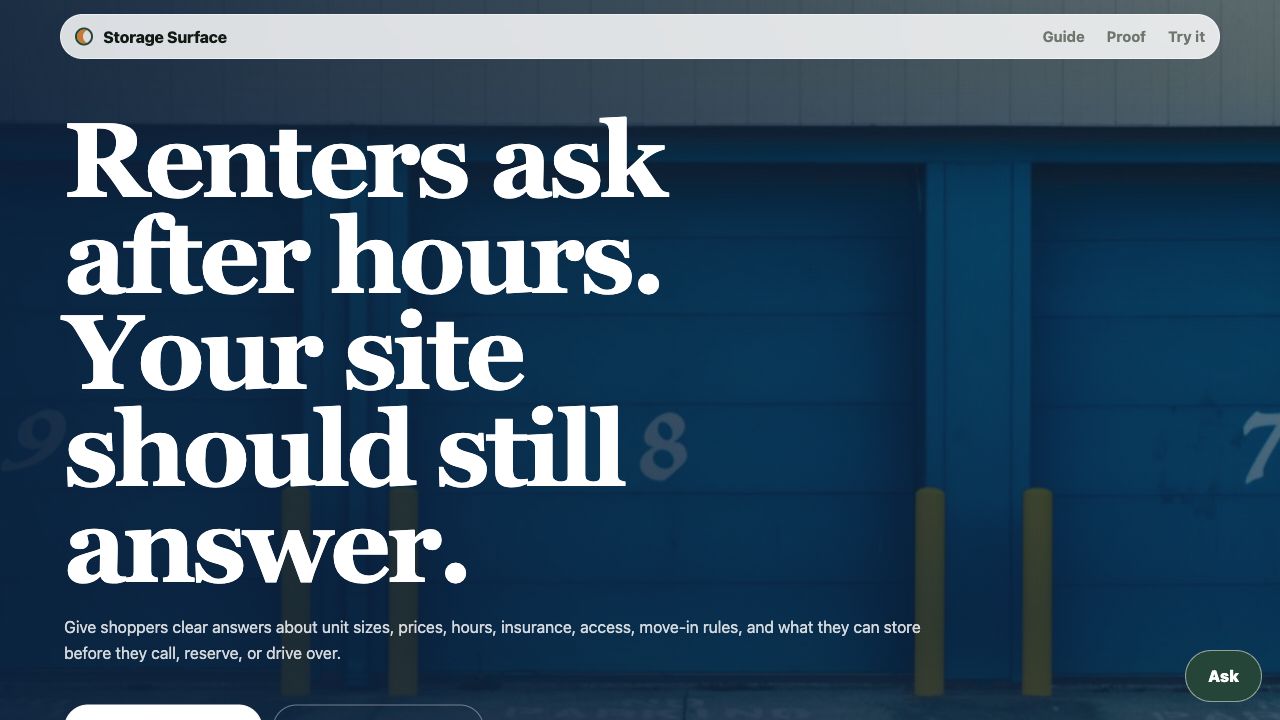 SMB guidance surface
Storage Rental
SMB guidance surface
Storage Rental
Proves: local-service guidance, renter questions, owner questions, facility-style support, and booking handoff.
Source posture: demo facility policy and configurable business facts.
Limit: not connected to a live unit inventory or payment system.
See live surfaceBuilt for high-context pages
Surface Assistant fits expert-led service businesses, consultants, agencies, technical founders, candidate proof surfaces, B2B teams with nuanced offers, and operators who keep explaining the same thing repeatedly.
Packaging
This is not a SaaS chatbot meter. The value is extraction, structuring, validation, surface fit, and guided conversion.
For an existing page or microsite. Answer pack, taxonomy, CTA routing, fallback policy, ugly-input tests, and deployment support.
I already have a page. Make it answer better.Page plus assistant, proof graph, CTA routing, and deployment when the surface and assistant need to be designed together.
My page and assistant need to be designed together.Workflow extraction, operating surface, assistant, proof structure, automation opportunity matrix, and implementation roadmap.
My workflow is trapped in my head or documents.Multi-surface systems with multiple assistants, proof graph, validation reports, and update planning.
I need multiple proof or workflow surfaces.Live guide
This page includes its own bounded Surface Assistant. It can explain the feature, compare it against chatbots and FAQs, route to proof, and prepare a demo request in dry-run mode.
Status: working proof surface / reference implementation. This is live and validated, but it is not a finished SaaS product launch. It demonstrates the assistant architecture, runtime boundaries, and validation workflow used to build deployable assistant surfaces.
FAQ
Surface Assistant is an AI-trained, bounded conversation layer for a specific page, offer, proof surface, candidate site, or operating surface.
Not by default. AI is used upstream to map likely questions. The deployed assistant can run from a controlled answer pack without unrestricted live model access.
Yes, through controlled action handoff. It can collect explicit contact details, require confirmation, sanitize the payload, and submit through configured action mode.
A chatbot tries to answer anything. Surface Assistant answers what this surface is allowed to answer and routes visitors to proof or action inside that scope.
No. This is a working proof surface and reference implementation. It is live, deployed, and validated for evaluation, but it is not presented as a finished SaaS platform with accounts, billing, admin dashboards, SLAs, or full support operations.
The assistant uses confidence thresholds, fallback boundaries, ugly-input tests, and suggested follow-ups so it can recover without making unsupported claims.
Pricing depends on scope. It can be an add-on to an existing page, part of a tailored operating surface, or included in a Business OS Extraction engagement.
Surface Assistant
Request a demo through the assistant, or text SURFACE to start the conversation directly.